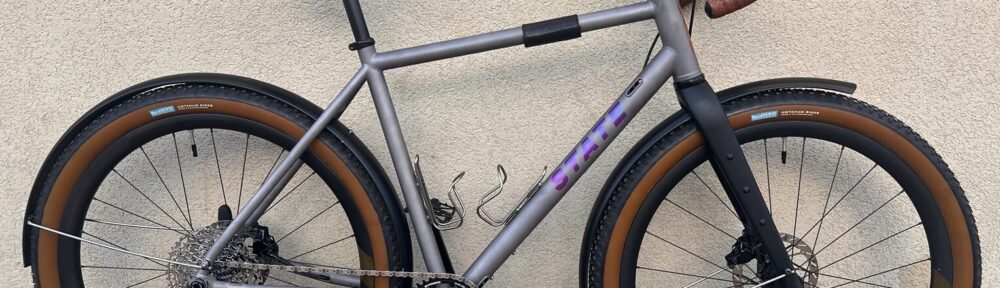
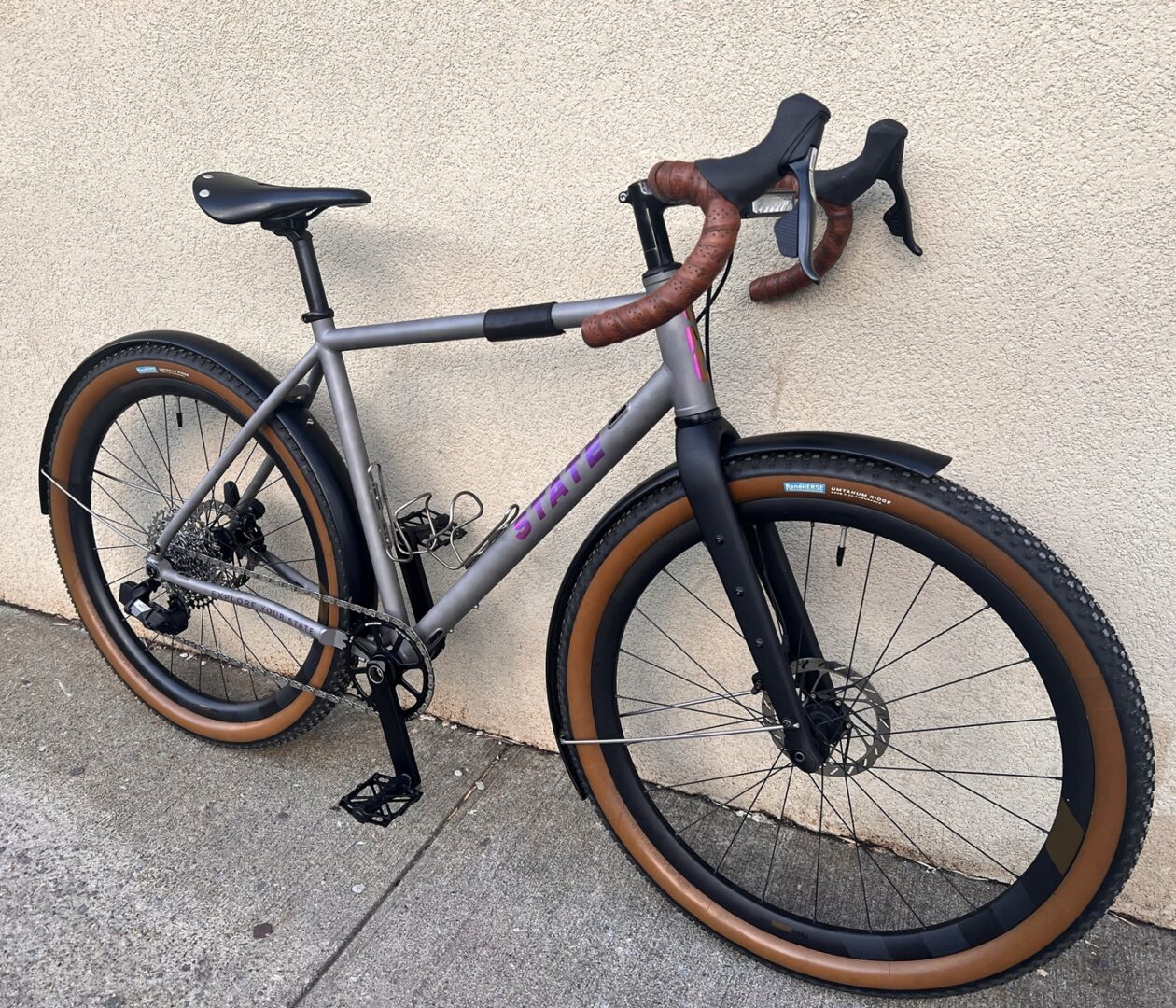
My love affair with State Bicycle’s “All-Road” series of gravel bikes was sparked by their 4130 model, which I reviewed in this post. After riding that bike for two years, I only had one complaint: the weight. Twenty-seven pounds in its stock configuration (spec sheet here), and closer to forty when outfitted with racks and bags. The chromoly steel tubing yields a smooth ride over rough terrain, but that’s a lot of bike to get moving! As I huffed & puffed my way up yet another bridge, I considered the eternal question of cycling. An age-old conundrum that every cyclist eventually finds themselves pondering: what if I could have the same bike, but lighter and better? Enter State’s Titanium All-Road gravel frame. After saving up and waiting a year for State to build a new run of these frames, I finally got my hands on one. Read on for the build, first riding impressions, and a little titanium bike history.
This was my first foray into titanium (abbreviated as “Ti” for the cool kids), an exotic frame material that has had a cult following since the 1990s. For a good starter history of titanium bikes, I recommend this article by Mike Davis, in a 2011 issue of Privateer Magazine and this primer from Seven Bicycles that includes a detailed timeline.
In summary: the first Ti bikes appeared in the 1970s, and were made from pure titanium. This material lacked the stiffness of steel and was prone to cracking. In the late 1980s, oversized tubing made from a titanium alloy called 3Al-2.5V yielded the perfect mix of ride quality and durability. Brands like Merlin and Lightspeed used this tubing to build the first titanium mountain bikes, as well as road bikes. Ti found an early champion in Greg LeMonde, who rode a Merlin-built Extralight bike in the 1991 Tour de France. Throughout the 90s, Ti bikes were ridden in all of cycling’s biggest races. However, by the early 2000s it was clear that the future of professional cycling would not be titanium: aluminum and carbon proved to be stiffer, lighter, and most importantly, significantly cheaper to manufacture. 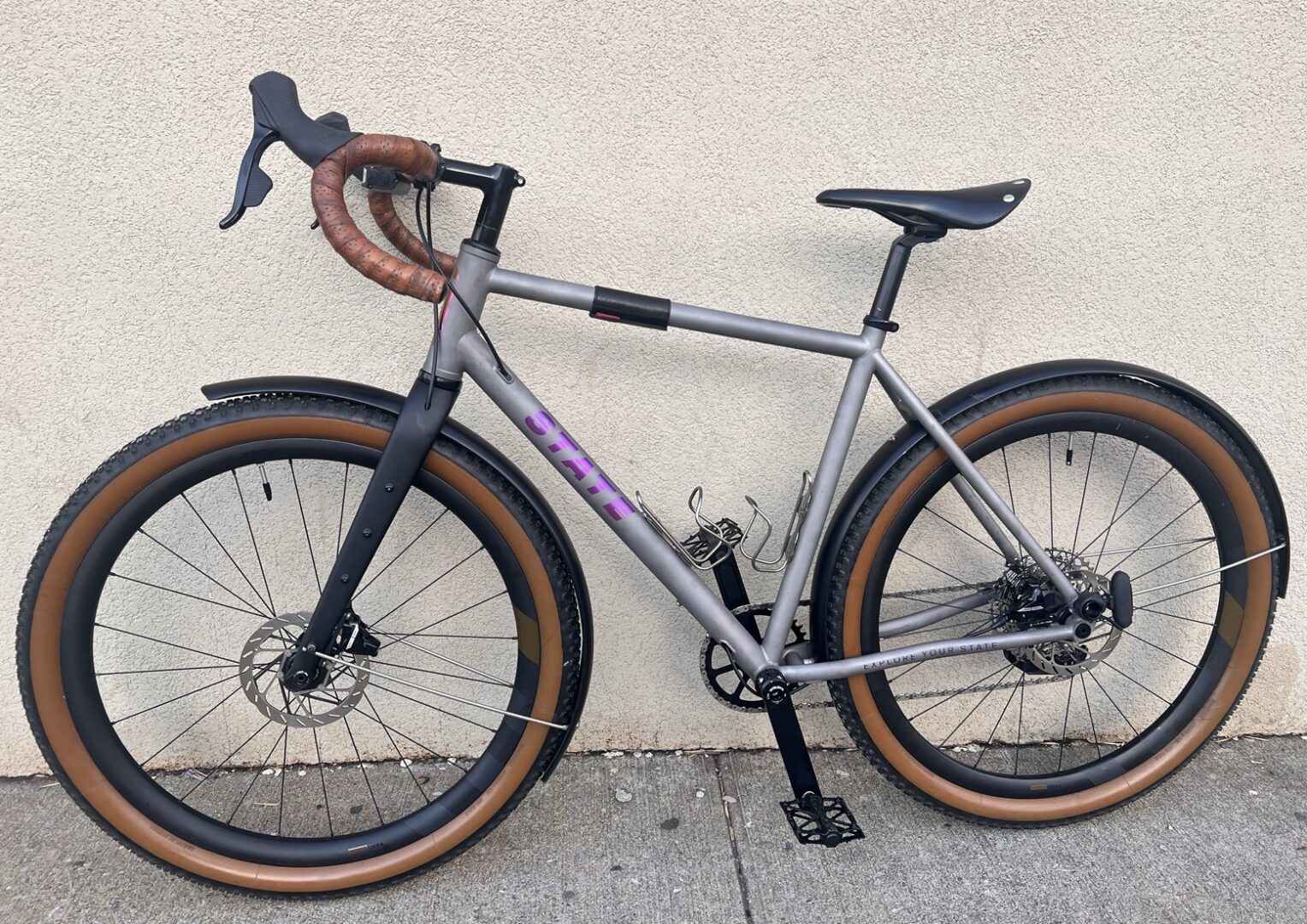
Despite losing popularity in the top echelons of road racing, titanium has remained a popular “premium” material, thanks to its legendary ride quality. It takes exceptional skill to weld titanium, but it’s extremely versatile and therefore popular with custom frame builders. It might have stayed a niche option for affluent cyclists seeking a perfect “forever bike,” but by the later 2010s, factories in China began offering semi-custom Ti frames at affordable prices. Over time, the quality of these frames has been proven, allaying early skepticism from American cyclists (an increasingly familiar story these days).
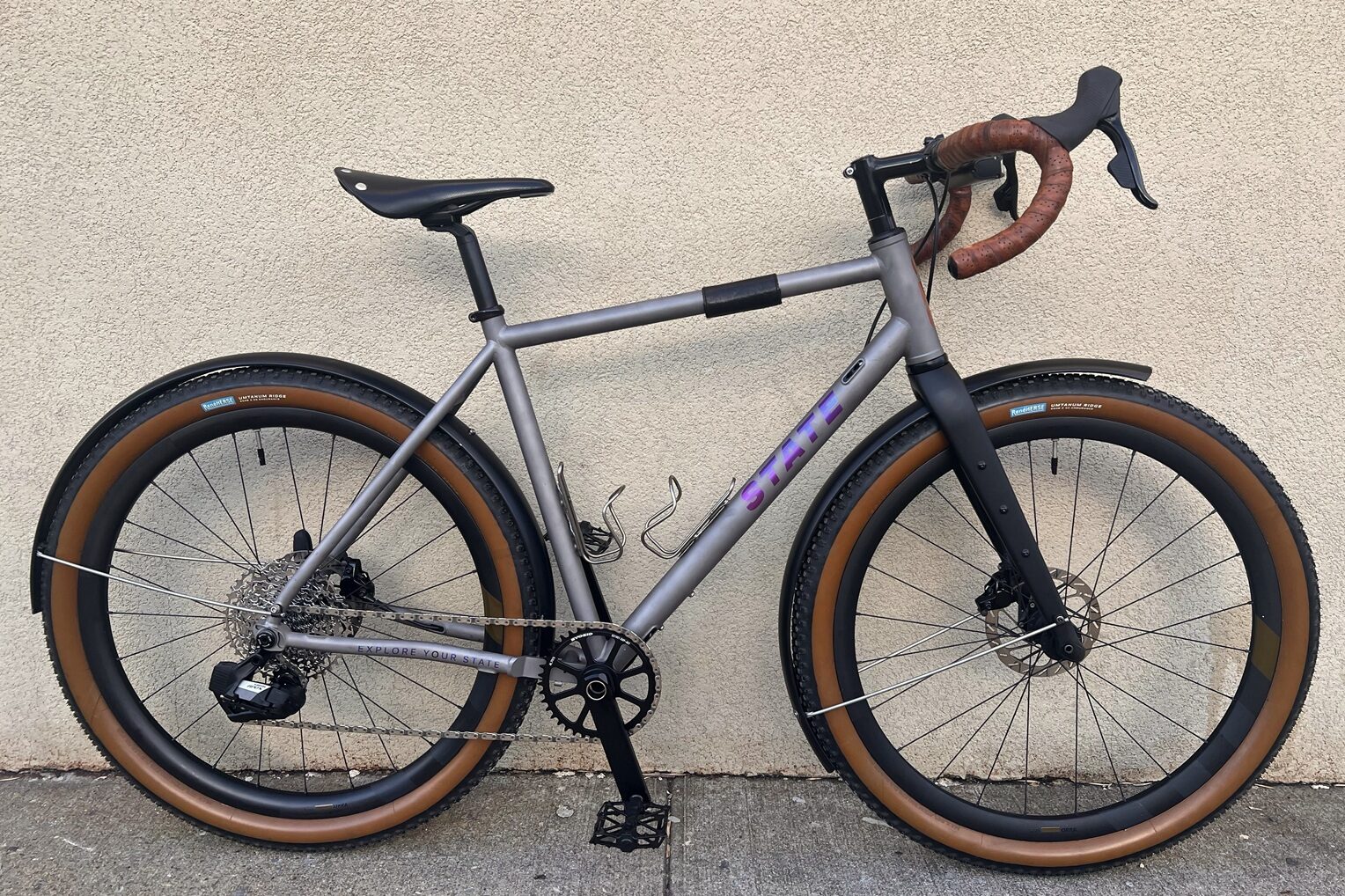
This set the stage for the options in front of me when deciding on my first Ti bike. With all due respect to custom frame builders, there’s nothing special about my body shape or my cycling needs to justify a bespoke frame. What won me over to State’s Titanium All-Road was its clearance for tires over 2 inches / 55cm (spec sheet here). I loved the ride of the Rene Herse “Umtanum Ridge” tires on my 4130 All-Road and I didn’t want to give them up. No other stock titanium frame under $2K had clearances for tires this wide, and given the great experience I had with the 4130, State was a slam-dunk. I was especially stoked to find one in my size in their Warehouse Deals section, for just under $1K.
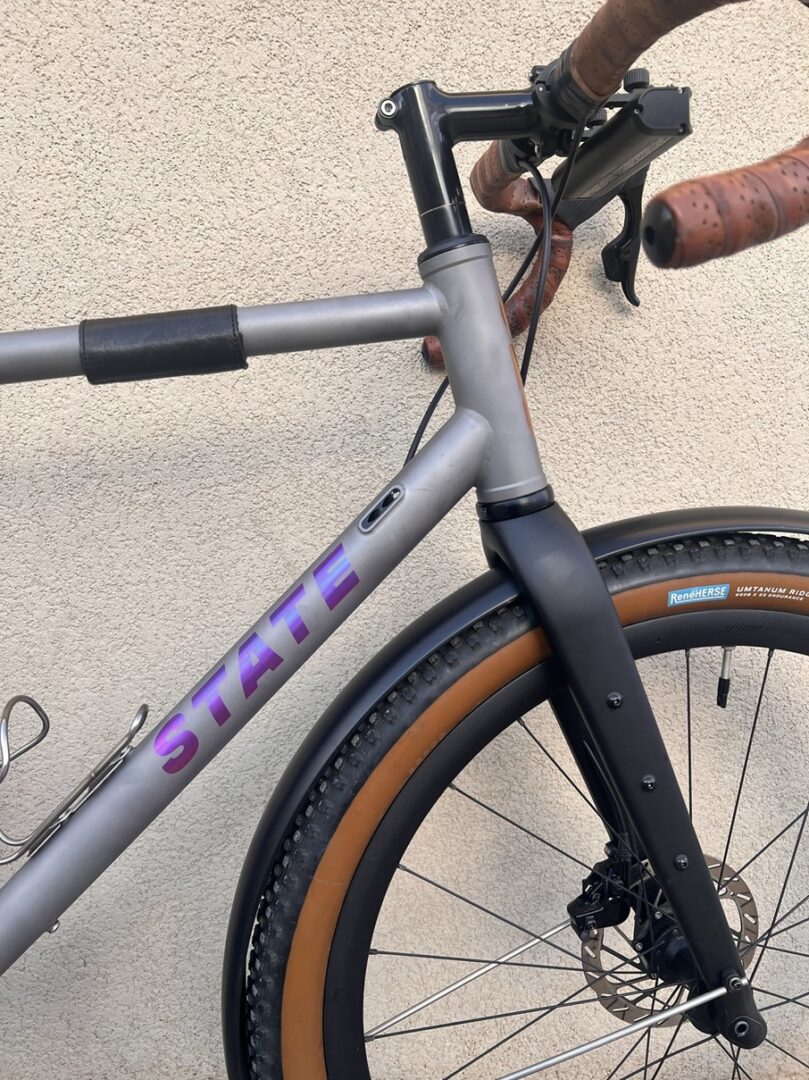
In order to fit a wide tire up front, I was going to go with State’s “Monster Fork” for $300, but then I found essentially the same fork on AliExpress for $100. Made by “SP Cycle,” it has a “flip chip” that allows you to change the rake 49mm or 55.5mm. I initially set it up with the 55.5mm rake, but I didn’t like how it handled (not nimble enough) so I flipped the chip to 49mm and it was perfect.
I moved the wheels, tires, fenders, cockpit, seat post, and saddle from the 4130 All-Road over to the Ti All-Road. Originally, I was also going to keep the previous drivetrain of Ingrid cranks, derailleur, and SRAM mechanical shifters. However, I just couldn’t resist the siren song of electronic shifting. I got my hands on a set of SRAM Force D1 AXS shifters which are compatible with mechanical disc brakes, so I could keep using my Paul Klamper brakes. I paired them to a SRAM Apex AXS XPLR rear derailleur, flat-top chain, and SRAM 11-44T PG-1231 cassette compatible with a Shimano HG freehub.
Unfortunately, when I went to assemble the bike, I discovered that I couldn’t use the Klampers with the internal cable routing on the fork. I put the D1 shifters in storage for a future build and picked up a set of Force D2 AXS shifters & hydraulic calipers. Finishing off the build, I picked an inexpensive set of Goldix 22S 165mm alloy cranks from AliExpress with a 40T narrow-wide chainring. Upon first assembly, shifting was messy and inaccurate… which was all my fault. Having almost two decades of experience wrenching on bikes has made me both cocky and lazy, which is not a good combination when you’re working with new technology. After spending another day in my shop watching SRAM’s video tutorials and using their AXS phone app, I had it dialed in.
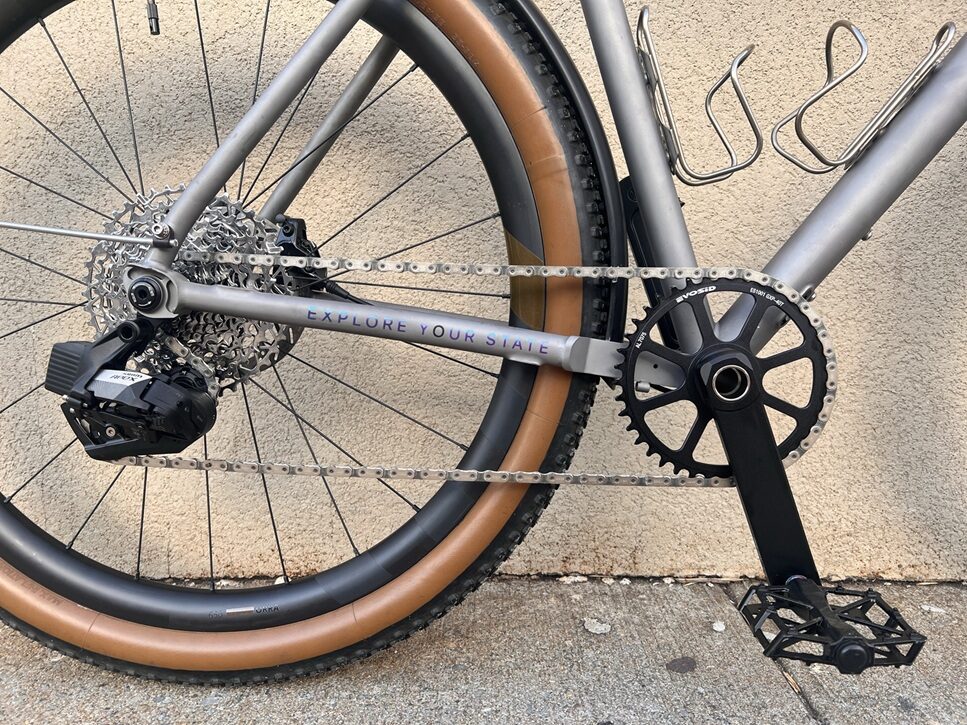
I’ve been riding the bike for the past three weeks, as New York City currently endures one of its coldest winters in decades. The lightness of the titanium frame is immediately apparent, and handling is lively. It achieves what I initially hoped it would: all of the attributes of the 4130 All-Road that I loved, without the weight penalty. For comparison, the 4130’s frame & fork weigh a little over eight pounds, while the Titanium All-Road frameset is about four pounds. The ride quality goes beyond the light weight, absorbing road shock and vibration like a heavy steel frame, without giving up any responsiveness or agility. I’m enjoying every ride, despite the streets being a frozen nightmare of dirty gray snow and ice.
Over time, I plan to replace the seat post and crankset with carbon versions. I might also replace the cockpit as well, although I really like the classic look of the NITTO UI-7 steel stem, which doesn’t play nice with carbon bars. I also need to figure out the rack situation, since the new fork won’t fit the racks I was using on the 4130. That’s all in the future for now, as this bike rocks as-is. Congrats to State for bringing a truly affordable, excellent Ti frame to market, with room to fit the fattest tires out there. If you’re Ti-curious, check out the Titanium All-Road from State – you won’t be disappointed!